
Should I Quit My Job?
1,000 simulated futures on your job-quit decision, not a gut check.
Visit
0 upvotes
This project is scheduled for launch
Launch date: Monday, November 2, 2026 at 08:00 AM UTC
Scheduled
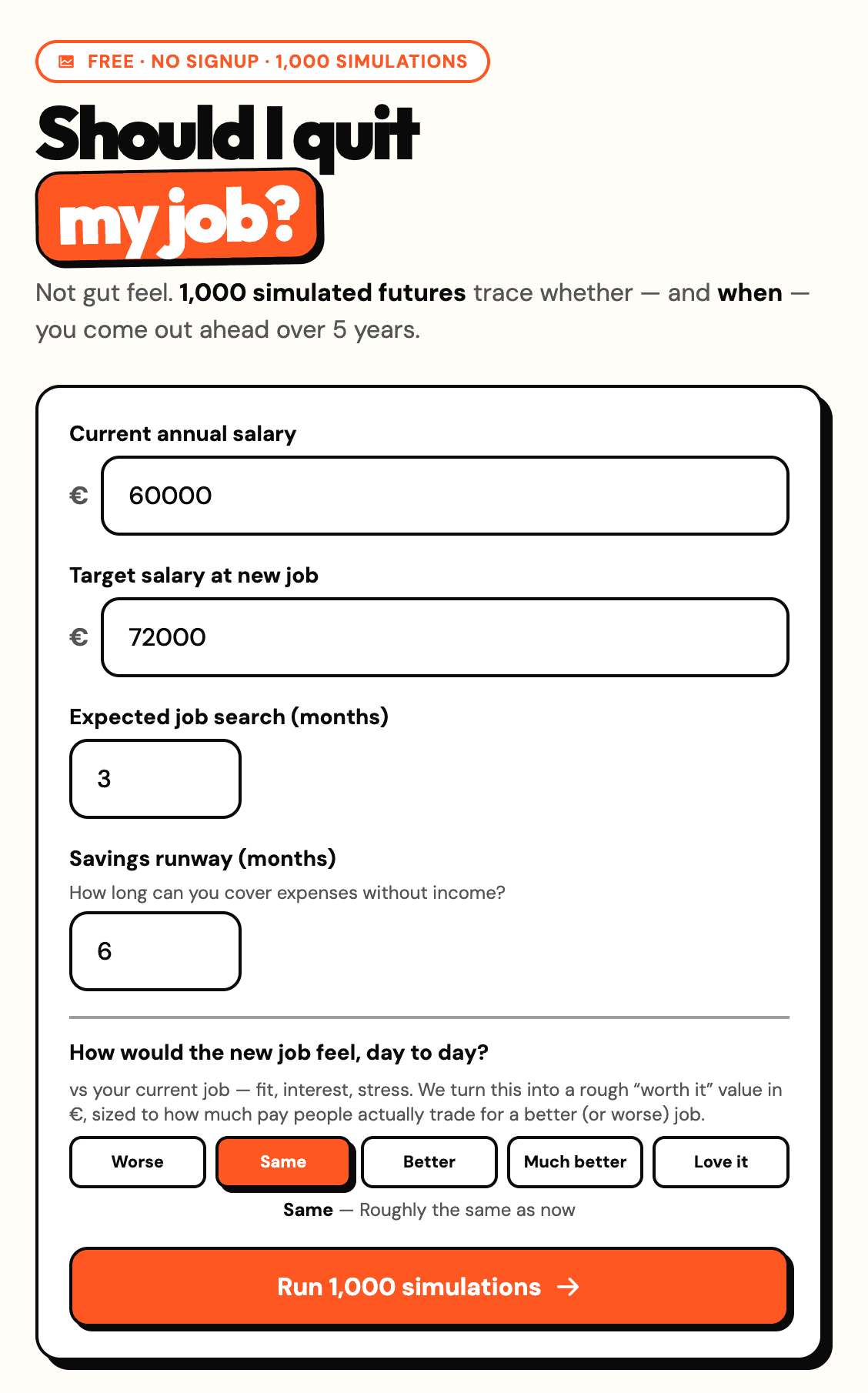
 I've been building LifeOdds (a Monte Carlo decision engine for big life choices) and kept coming back to "should I quit my job" as the single most universal, highest-stakes version of that problem. So I looked at a dozen existing calculators for it to see how they handled the two genuinely uncertain variables — how long a job search actually takes, and what you actually land. Every one treats both as fixed inputs. Pick a number, get an answer, done. That's not a simplification, it's most of the real risk in the decision, hidden.

So I built [Should I Quit My Job](https://shouldiquitmyjob.app) to run it properly: 1,000 Monte Carlo simulations over a 5-year horizon instead of one guess. Four inputs — current salary, target salary, expected search length, savings runway — and it varies the uncertain ones across realistic ranges (searches consistently run longer than people expect), compounds raises on both paths, and reports the break-even month, your odds of being ahead at year 1/3/5, and the case every single-point calculator misses entirely: your search outlasting your savings before you land anything.

One thing I'm genuinely undecided on: an optional fifth input for how the new role would actually feel day to day, converted to a rough yearly value using real compensating-wage-differential research (not a random slider). Feature or scope creep? Curious what this community thinks.
Comments
Comments will be available once the project is launched.
Publisher

Patrick Jaritz
Launch Date2026-11-02
Platformweb
Pricingfree
Tags
#free#simulation#decision making#career planning#personal finance
Sponsors
