
MiroFish
AI simulation chat that turns a question into a simulated world and a prediction report
Visit
0 upvotes
This project is scheduled for launch
Launch date: Tuesday, February 16, 2027 at 08:00 AM UTC
Scheduled
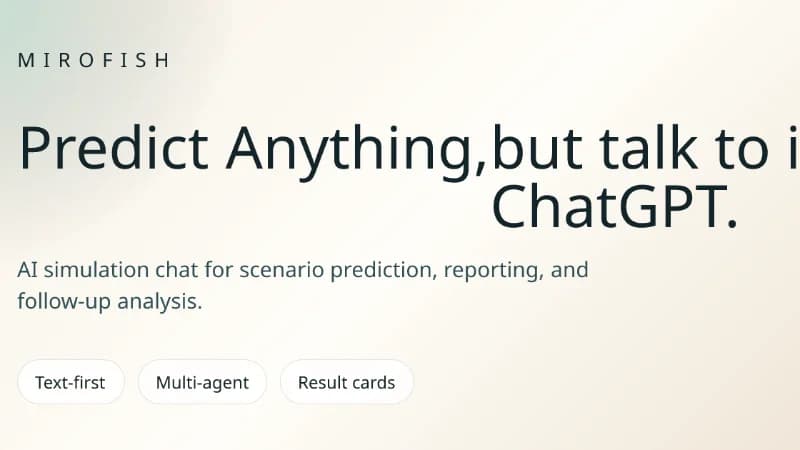
MiroFish is an AI simulation chat tool for scenario prediction. It is built around a simple idea: instead of asking for a single static answer, you ask a question in plain language and let the system run a full prediction workflow behind the scenes. That workflow moves through seed material, knowledge graph construction, multi-agent simulation, prediction reporting, and deep follow-up interaction, while the user stays inside one continuous conversation. The product describes itself as text-first, meaning you can start with a question and only add supporting files when you want the simulation grounded in a specific document. Optional attachments include PDF, Markdown, and TXT files.
The workflow is presented in five steps. Step 01 is Seed Material: you start from a plain-language question, a report, a policy draft, a market note, or a story fragment. Step 02 is Knowledge Graph: the system extracts actors, relationships, pressures, and factual anchors so that agents reason from structure rather than from an isolated prompt. Step 03 is Agent Simulation: personas interact across short-form and threaded social surfaces over multiple rounds. Step 04 is Prediction Report: emergent behavior is condensed into turning points, risks, confidence signals, and follow-up paths. Step 05 is Deep Interaction: you continue asking questions against the generated world instead of stopping at a static answer.
MiroFish highlights several use cases where human reaction matters more than a static forecast. Campaign Test lets teams pressure-test a launch narrative before it goes public, simulating how audience groups might amplify, resist, or reinterpret a message before the first spend is committed. Pricing Reaction explores the friction behind a price increase by modeling customer sentiment, value perception, and likely objection paths across segments before the change is announced. Policy Stress Test works as a tabletop exercise for controversy, coalition formation, and second-order reactions in a policy rollout. Market Narrative watches narrative, incentives, and sentiment interact, stress-testing market stories where spreadsheets miss the feedback loop between analysts, retail attention, and public discourse.
The site also offers practical playbooks. One advises writing a sharper prediction prompt by naming the decision, the audience, the likely trigger, and the time horizon, since a narrow question gives the simulated world less room to drift. Another suggests using files as reality seeds, noting that PDF, Markdown, and text files work best when they contain concrete actors, incentives, constraints, or prior context, such as a strategy memo, product FAQ, policy brief, market note, or customer research summary. A third playbook recommends reading the report like a rehearsal: treat the output as decision support, look for resistance signals, narrative bridges, and assumptions worth checking with real data.
A report preview on the site shows the expected structure: an executive summary, risk signals, narrative paths, and follow-up questions. In the sample scenario about a product raising prices next quarter, the summary states that the highest-risk path is not the price change itself but a compressed story that turns the announcement into a trust issue before value evidence is visible. Risk signals include early backlash from price-sensitive segments, narrative compression into a simpler accusation, and influencer framing that outruns the official message. Narrative paths include a value story that holds if benefits are concrete, a skeptical thread that grows if comparison charts are absent, and supporters who need reusable language rather than only a launch post. Follow-up questions ask which persona creates the first negative cascade, what changes if a transition plan is announced, and which evidence line reduces confusion fastest.
The site compares MiroFish with alternatives. A single chat answer is fast and useful for brainstorming but often collapses competing audience reactions into one confident response. Manual research is grounded and careful but slow when a decision depends on many groups influencing each other at once. MiroFish simulation explores a living scenario with agents, memory, social surfaces, emergent clusters, and a report you can keep questioning. The FAQ notes that good fits are scenarios with human reaction loops such as launches, pricing changes, policy debates, market narratives, crisis response, and creative continuation. Files are optional; you can start with text and add files later. A report should summarize the likely trajectory, key actors, risk signals, evidence lines, and next questions. The product is explicitly not a guaranteed forecast and is positioned as exploratory decision support for rehearsing plausible reactions before using judgment, analytics, and real-world validation.

