How to Write a Product Launch Announcement That Converts Visitors Into Users
A product launch announcement isn’t “news.” It’s conversion copy designed to turn attention into activation. This guide breaks down the structure that works: lead with outcomes, explain the mechanism fast, stack proof, remove risk, and drive a single clear next step. You’ll also learn how to prevent message-to-landing-page mismatch, write stronger headlines and microcopy, distribute across channels, and iterate for higher sign-ups after launch day.
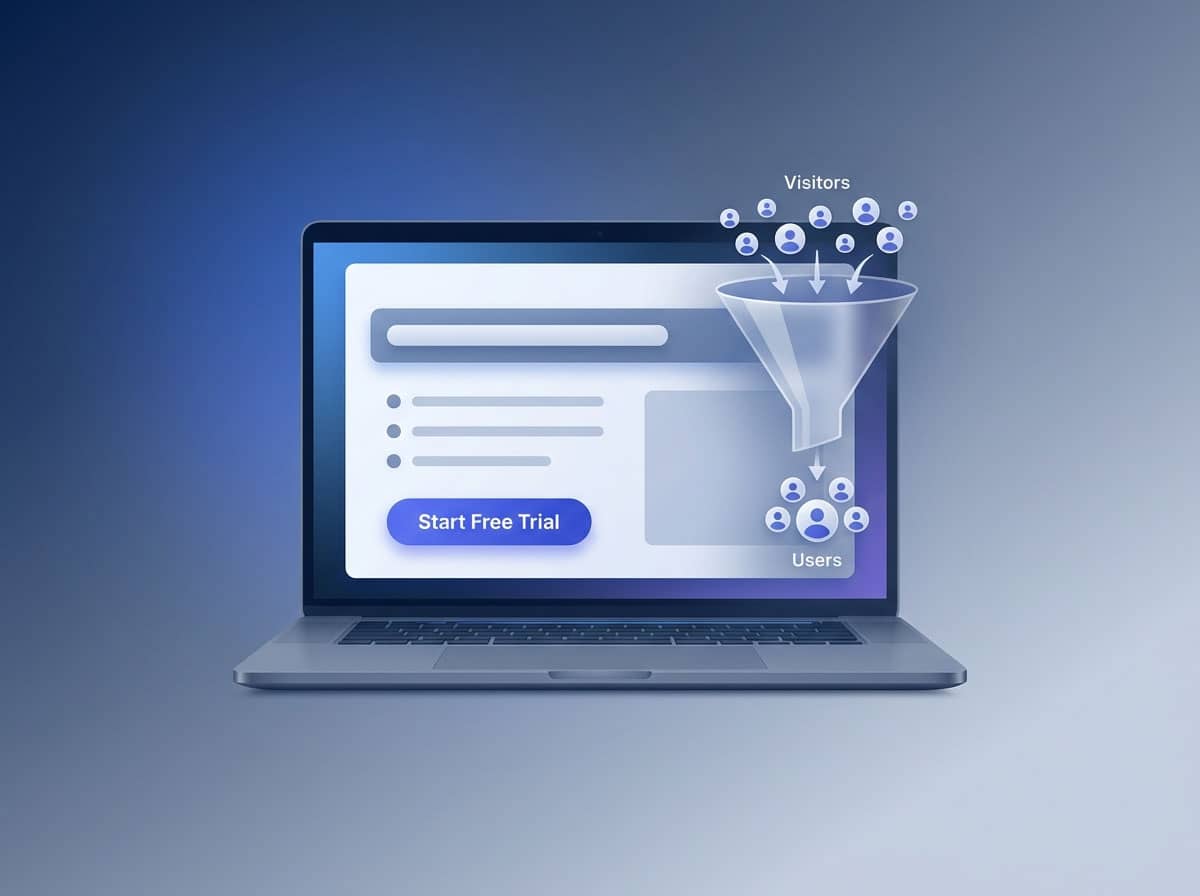
A product launch announcement is not a press release with better formatting. It’s a conversion asset. It should take a stranger who’s skimming between meetings and move them into their first real product moment. Not applause. Not vague interest. A sign-up, a trial, a waitlist join, or a booked call.
Consequently, the best launch announcements read less like “news” and more like a guided shortcut to value.
Why Most Product Launch Announcements Fail to Convert (And What “Convert” Actually Means)
Most SMB launches miss because they aim for awareness when they need activation. “Convert” means something specific, even for a small business with a broad audience.
- SaaS: trial start, onboarding completion, first key action
- Ecommerce: email capture, add-to-cart, purchase
- Service SMB: consultation request, booked call, paid deposit
If your announcement does not push one of those forward, it performs like a billboard. It looks nice. It changes nothing.
Furthermore, three failure modes show up again and again:
- Feature dumping. Readers cannot translate ten features into one reason to act.
- Generic targeting. “For teams of all sizes” often means “for nobody.”
- Weak next step. A CTA like “Learn more” signals uncertainty, then friction finishes the job.
But the most painful failure is quieter. Your announcement promises one experience and your landing page delivers another. If you promise “set up in 10 minutes” and the first screen asks for seven integrations, trust evaporates.
The Conversion Psychology Behind a Product Launch Announcement That Converts Visitors Into Users
High-performing announcements follow a simple hierarchy: Outcome → Mechanism → Proof → Action. This sequence matches how real buyers evaluate risk.
Outcome states what changes for the reader.
Mechanism explains how the product delivers that change without drowning them in architecture.
Proof removes the “sounds nice” skepticism.
Action gives a clear, low-friction next step.
Conversely, if you lead with mechanism, you force readers to do the hardest work first. They have to infer why it matters.
Specificity builds credibility faster than hype
SMB buyers run tight budgets and tighter calendars. They do not want grand claims. They want believable ones.
- “Save time” becomes “cut weekly reporting from 2 hours to 15 minutes.”
- “Easy setup” becomes “connect to QuickBooks in under five minutes.”
Add a constraint when it is true. It signals honesty. “Best for teams under 25 seats” often converts better than “perfect for everyone.”
Risk reversal needs to feel practical
Risk reversal is not theater. It should lower the perceived cost of trying.
- No credit card required
- Cancel in one click
- Export anytime
- Live chat onboarding available
These lines work because they answer the unspoken question: “What happens if this doesn’t work for me?”
Before You Write, Nail the Positioning in One Sentence
If you cannot explain the product clearly in one sentence, the announcement will wander. Use a positioning line you can stress-test.
Template:
“[Product] helps [audience] achieve [outcome] by [mechanism] without [pain].”
Write three versions. Keep at least one close to the target idea, “a product launch announcement that converts visitors into users.” This forces you to center conversion instead of novelty.
Next, translate features into outcomes with a strict ladder:
Feature → capability → workflow change → business result.
For example, “auto-tag receipts” is a feature. The capability is “categorization without manual work.” The workflow change is “bookkeeping stops piling up.” The business result is “cleaner books and fewer end-of-month surprises.”
Finally, pick one primary CTA. One. You can still offer secondary paths later, yet one action must dominate visually and verbally.
The High-Converting Structure to Use Every Time
Think of the announcement as a sequence of conversion blocks. Each block answers one reader question and earns the right to move forward.
Above the fold: headline, subhead, CTA, and a visual that teaches
Your headline should lead with outcome, not ceremony. “Introducing” can work when you already have demand. Most SMBs do not. Aim for clarity.
A strong subhead clarifies three things: who it is for, what pain it removes, and what the first win looks like.
Then choose a visual that teaches fast. A screenshot, a short GIF, or a 20-second clip that shows the moment of value will often outperform paragraphs. That pattern shows up in product launch email guidance too, where clear value and product visuals consistently support stronger CTAs. See: https://userpilot.com/blog/product-launch-email/
The problem framing block: short, concrete, familiar
Describe the before-state in lived terms. One paragraph. No melodrama.
“Every Friday you rebuild the same report from three spreadsheets, then you wonder which numbers changed.”
Readers should nod before they scroll.
The “new way” block: mechanism without overload
Explain how it works in 3–5 bullets. Make them sequential.
- Connect your data source
- Choose a template that matches the job
- Generate the first output automatically
- Share it or export it
- Improve it with saved rules
This gives the brain a path. It also reduces uncertainty.
The “what’s included” block without feature soup
Group features by job-to-be-done. It makes the product feel designed, not assembled.
- Setup and integrations
- Core workflow
- Reporting and exports
- Collaboration and permissions
- Security and controls
End each bullet with the outcome. “Role-based permissions so clients only see what they should.”
Proof stack: credibility in layers
Proof should match the headline claim. Stack it from strongest to weakest.
- A quantified result
- A customer quote with context
- A recognizable logo, if you have it
- A compliance or security note
- A specific usage number that means something
Objections: answer the “yeah, but…” questions
Handle objections with calm specificity.
- Will this work with my stack?
- How long will setup take?
- Is it for someone like me?
- What if I outgrow it?
Each answer should be two to three sentences. Keep the tone factual.
CTA that converts visitors into users
Your primary CTA should describe the action and the outcome.
“Start a free trial and generate your first report.”
Add one line under it that removes risk. “No credit card required. Cancel anytime.”
Write the Copy With Proven Formulas, Then Make It Yours
Use AIDA as a diagnostic tool, not a cage. It helps you confirm flow: attention, interest, desire, action.
But your secret weapon is microcopy. Button text, form helper lines, and post-click reassurance can lift conversions without rewriting the whole page. Say what happens next. Say how long it takes. Say what you will not do.
Distribution: One Announcement, Many Surfaces
A launch announcement that converts visitors into users cannot live in one place. Repurpose it into a simple sequence.
- Website announcement page
- Email to your list
- In-app message for existing users
- Social post with one use case
- Partner mention if relevant
Segment even if your audience feels broad. Swap one paragraph and one example for different roles or industries. That small effort often doubles relevance.
Post-Launch Optimization: Treat the Announcement as Version 1.0
Measure activation, not applause.
Track landing conversion rate, time-to-first-key-action, onboarding completion, and day-7 retention. Then iterate for 14 days with discipline. Change one variable at a time: headline, hero visual, CTA copy, proof placement, FAQ order.
Finally, build follow-up assets that keep converting after launch week. Ship a tutorial, a short demo video, a use-case page, and a changelog entry that links back.
Because the real win is not the launch. It’s the reader hitting their first success and thinking, “Okay. This actually works.”