Best Product Launch Platforms for Startups in 2026: Where to Get Real Traction
In 2026, a “big launch” can still leave you with zero revenue. Real traction comes from compounding signals: qualified clicks, buyer-intent conversions, actionable feedback, and long-tail visibility from indexed listings and backlinks. This guide ranks 10 product launch platforms indie makers can use to get durable reach, then shows how to stack them into a 14-day launch sprint with measurement that prevents self-deception.
If you’re an indie maker, you already know the uncomfortable truth. A “successful launch” can still leave you with zero revenue and a week-long dopamine hangover.
In 2026, real traction means your product earns attention that converts, feedback that clarifies positioning, and visibility that persists after launch day. Consequently, the best product launch platforms for startups in 2026 are the ones that produce compounding signals. Not just a spike.
This guide breaks down where to launch in 2026 to get real traction and how to use each platform like a serious distribution experiment.
Why “real traction” looks different in 2026
Two things changed.
First, discovery fractured. Your buyers do not gather in one place anymore. They drift between niche directories, founder communities, and “tool discovery” feeds that behave like lightweight search engines.
Second, platforms quietly optimized for consistency. A single launch day surge matters less than the long tail of indexed pages, backlinks, and repeated discovery.
So define traction like an operator, not like a spectator.
- Revenue traction: trials that convert, purchases that stick, expansions that happen without begging.
- Activation traction: users reach the “Aha” moment fast and they come back within seven days.
- Distribution traction: you earn backlinks and branded searches that keep arriving in week three.
Think of a launch as a lab test. You are not “announcing.” You are validating whether your promise survives contact with reality.
How to choose the best product launch platforms for startups in 2026
Indie makers lose time by launching everywhere. You want two outcomes: signal density and repeatable reach.
Selection criteria that actually matter
Use these filters before you submit anywhere:
- Audience-fit: builders will give feedback, buyers will give money, and tourists will give neither.
- Intent density: does the platform attract people looking to solve a problem today?
- Conversion surface area: can you send visitors directly to a trial, checkout, or waitlist?
- Long-term discoverability: does your listing rank in Google, or die in 24 hours?
- Spam resistance: moderation quality sets the baseline for trust.
- Submission friction: time-to-publish and “pay-to-be-seen” mechanics change the ROI.
A simple scoring model you can run in your head
Score each platform 0–5 on:
- Buyer intent
- Reach quality
- Long-tail visibility
- Effort required (reverse score)
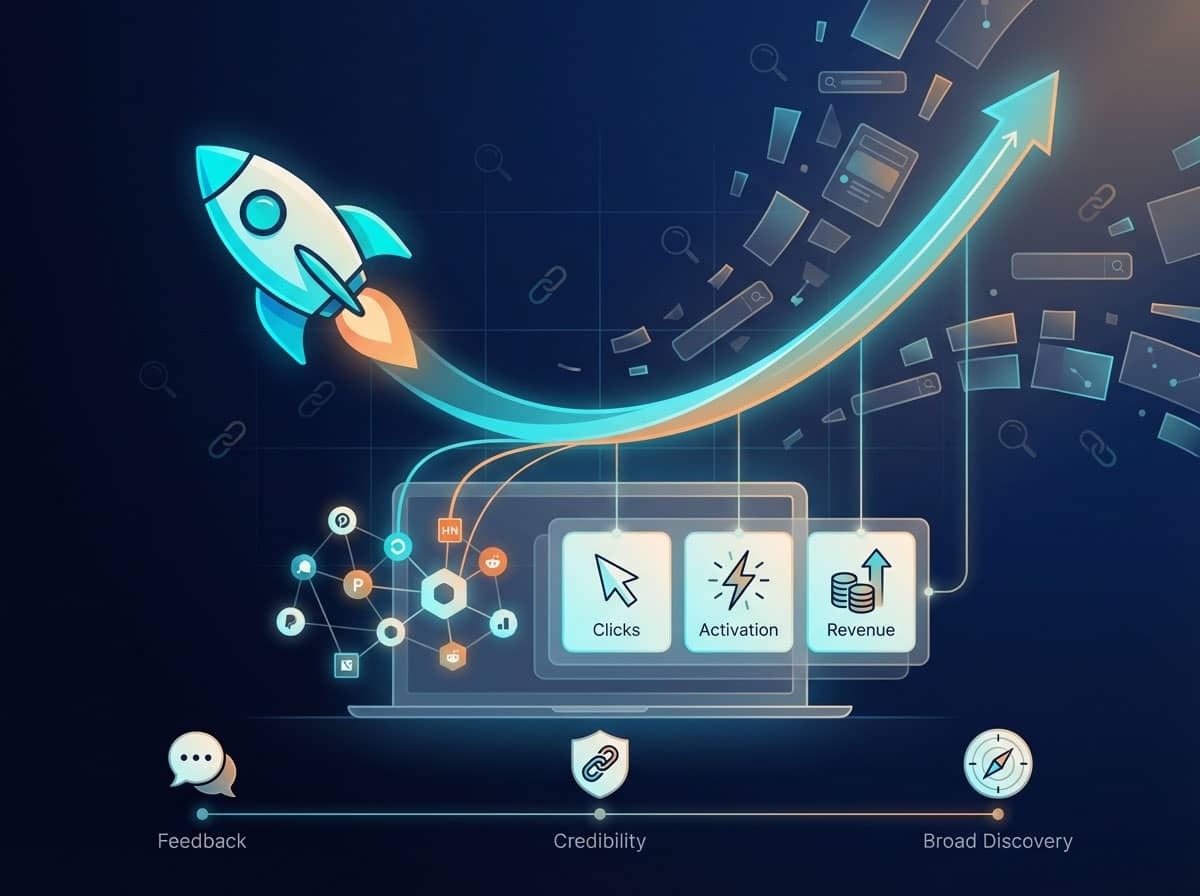
Then pick three. One for feedback, one for credibility, and one for broad discovery.
Pre-launch assets you need before you hit submit
You do not need a perfect brand. You do need a clean path.
- One landing page, one primary CTA.
- One sentence of positioning: “For [ICP], [product] helps you [job] without [pain].”
- Proof, even small proof:
- screenshots, a 45-second demo, a benchmark, a testimonial, a founder story.
- A minimal email sequence:
- Day 0 (value + expectations), Day 2 (case or workflow), Day 7 (ask + offer).
The list: best product launch platforms for startups in 2026 (where to get real traction)
1) Stellar Launch — best for guaranteed visibility and SEO lift
Link: https://www.stellarlaunch.org
Stellar Launch positions itself as a launch platform that does not bury your project, with daily scheduled launches, permanent visibility, and high-quality backlinks. That promise matters because most directories behave like a scrolling graveyard.
Best for: indie makers who want predictable placement and a long-tail listing that keeps paying rent.
What traction looks like here: fewer clicks than massive feeds, yet higher conversion per click because the page context implies “new and vetted enough to be shown.”
Submission strategy: write like you’re solving one painful job. Lead with the transformation. Then show the mechanism.
Common mistake: treating the listing like a feature dump. Features do not sell. Contrast sells.
Measure: landing page conversion rate, trial starts per 100 visits, and the backlink-driven lift in branded search.
2) Direct2App — best for discovery-minded buyers comparing tools
Link: https://www.direct2app.com
Direct2App presents itself as a place to discover and compare SaaS and AI tools, with categories, tags, and sorting that resemble shopping behavior. That structure pulls readers toward evaluation, not vibes.
Best for: SaaS, AI tools, and utilitarian products with clear differentiation.
What traction looks like: steady referral visits from people already scanning alternatives.
Submission strategy: make comparison easy.
- Name the category you win.
- State the “why now” in one line.
- Clarify pricing and onboarding speed.
Common mistake: vague positioning like “all-in-one.” Conversely, specificity converts.
Measure: click-through rate to your site, trial-to-activation, and time-to-value.
3) Turbo0 — best for directory-style reach and lightweight SEO discovery
Link: https://turbo0.com
Turbo0 operates like a broad “products directory” with categories and listings. Practically, that means it can function as a secondary discovery channel and a backlink source, especially if your listing lands in the right taxonomy.
Best for: makers who want extra surface area across categories without heavy editorial lift.
What traction looks like: small consistent trickle, plus occasional bursts when categories trend.
Submission strategy: match your primary category precisely. Write the description for skimmers who decide in five seconds.
Common mistake: unclear “who it’s for.” If the reader cannot self-identify, they bounce.
Measure: long-tail visits from Google, bounce rate, and signups per visit.
4) Webspot — best for “web discovery” audiences who like browsing useful sites
Link: https://webspot.app
Webspot brands itself as “the ultimate web discovery platform” for top sites, tools, and “hidden gems.” That tone attracts curious, productivity-driven readers. They browse like collectors.
Best for: web apps with a fast demo loop and immediate utility.
What traction looks like: strong top-of-funnel attention, then conversion only if onboarding feels effortless.
Submission strategy: make the first impression visual. Screenshots matter. Your first sentence should name the job.
Common mistake: burying the setup cost. If it takes 30 minutes to see value, you lose them.
Measure: time on site from Webspot traffic, activation rate, and “second session” within seven days.
5) Open-Launch — best for low-friction submissions and backlink/badge utility
Link: https://open-launch.com
Open-Launch pushes a simple promise: submit, get a badge, get a backlink. The listings feel more open and less curated. That can be useful when you want speed and another indexed asset.
Best for: early-stage products that need more discovery pages and lightweight proof elements.
What traction looks like: modest clicks, plus credibility signals you can reuse elsewhere.
Submission strategy: keep it honest and crisp. A clean demo plus a clear CTA beats hype.
Common mistake: assuming the platform will “do the marketing.” It will not.
Measure: referral conversions and whether the listing ranks for niche keywords.
6) Huzzler — best for founder-grade feedback in an AI-free community
Link: https://huzzler.so
Huzzler differentiates hard: “strictly AI-free community” and “Stripe-verified revenue only.” That posture increases trust because it filters out the worst kind of noise. You get humans who build.
Best for: indie makers who want feedback that hurts a little, in a useful way.
What traction looks like: fewer raw clicks, more actionable comments, and better clarity on positioning.
Submission strategy: post with a question.
- “Which headline makes you want to try this?”
- “What would stop you from paying $19/month?”
- “What did you expect to happen on first use?”
Common mistake: showing up only to promote. Communities punish drive-bys.
Measure: quality of feedback themes, DM conversations, and conversions from engaged threads.
7) TinyLaunch — best for high-authority backlink mechanics and launch-period competition
Link: https://www.tinylaunch.com
TinyLaunch explicitly advertises a DR 68+ backlink via an embedded badge, plus ranked launch periods and visible winners. That is not just marketing. It’s an SEO and credibility lever.
Best for: makers who want SEO benefits and competitive launch visibility.
What traction looks like: a mix of leaderboard attention and longer-term SEO value if you implement the badge correctly.
Submission strategy: treat it like a mini-campaign. Drive your existing audience during the launch window, then follow up with updates.
Common mistake: forgetting to embed the badge properly, which can forfeit the backlink benefit.
Measure: backlink acquisition, keyword lift, and conversion rate from launch traffic.
8) Launchpad — best for homepage visibility, rankings, and dofollow backlink incentives
Link: https://launchpad.ms
Launchpad emphasizes “instant visibility on our homepage,” “daily rankings,” and “high-authority dofollow backlinks.” It behaves like a gamified launch feed, yet it also offers persistent listings.
Best for: products that benefit from ranking dynamics and a credibility bump.
What traction looks like: short-term bursts plus backlinks that help future discovery.
Submission strategy: ship a tight story and show proof quickly. Ranking systems reward momentum.
Common mistake: launching with unclear pricing. Buyers do not chase mystery.
Measure: referral conversion, backlink impact, and follow-on direct traffic.
9) FastLaunch — best for daily discovery feeds and rapid exposure
Link: https://fastlaunch.io/
FastLaunch frames itself as a “daily destination” to discover and launch products, with premium placements and a steady stream of new projects. The rhythm suits makers who like consistent shipping.
Best for: frequent shippers and products with strong demo content.
What traction looks like: quick awareness spikes that you can convert with sharp onboarding.
Submission strategy: pair the submission with a time-bound reason to act. Give a perk for early adopters.
Common mistake: sending traffic to a slow, generic homepage. Route to a single-purpose landing page.
Measure: trial starts in the first 72 hours and activation time.
10) OpenHunts — best for weekly launch cycles and maker-friendly discovery
Link: https://openhunts.com
OpenHunts runs weekly cycles and highlights launches, sponsors, and winners. That cadence creates a predictable moment for attention, which helps if you plan distribution like a calendar.
Best for: makers who want structured launch timing and consistent visibility.
What traction looks like: community engagement plus referral traffic that aligns with the weekly cycle.
Submission strategy: publish early in the cycle, then stay active. Answer comments. Update your listing.
Common mistake: treating it like a one-and-done post. Momentum requires presence.
Measure: click quality, comment sentiment, and downstream conversions.
How to stack launch platforms in 2026 (a practical sequencing playbook)
You’ll get better results by sequencing platforms than by shotgun posting.
Phase 1: Feedback-first (days 1–3)
Launch where builders talk back. Use Huzzler-style discussion to find objections and rewrite your promise.
Phase 2: Credibility and backlinks (days 4–10)
Submit to platforms that create persistent assets and dofollow backlinks, such as TinyLaunch, Stellar Launch, and Launchpad.
Phase 3: Broader discovery (days 11–14)
Add directory-style reach with Direct2App, Webspot, Turbo0, FastLaunch, and OpenHunts.
Keep one canonical landing page. Change the angle per platform. Your product stays the same.
Measurement: the traction dashboard that keeps you honest
Track three tiers. Do not negotiate with yourself.
- Attention: impressions, clicks, CTR, and time on page.
- Activation: signup, install, trial start, and time-to-first-value.
- Revenue: paid conversions, churn, refunds, and expansion.
Use UTM parameters everywhere. Otherwise, you will “feel” success without being able to repeat it.
The common failure modes indie makers still repeat
- You launch before onboarding works. Then you blame the platform.
- You optimize for votes. Then you wonder why revenue stays flat.
- You treat feedback as feature requests. You should treat it as positioning data.
- You stop after launch day. Real traction starts after the spike.